I had a great conversation with a fellow GCT recently, and we discussed the idea of 1:1 programs. He brought up a valid point - often, a 1:1 program is adopted, but the technology alone doesn't make a transforming difference in the classroom. We appreciate the new tools. They're faster, easier, and (hopefully) more engaging than using paper and pencil, but if we treat the technology like a $1,000 pencil and paper, that's what we'll get in return. What makes these programs a success is when students and teachers are reaching the upper levels of SAMR and Bloom's in real and relevant learning opportunities.
This also got me thinking about device selection. Being a part of five different 1:1 programs, I've employed successful use of laptops, Chromebooks, and iPads. Often, I am asked by colleagues what device they should choose. My answer is, "What are you wanting students to be able to do as a result of your 1:1 program?" It's not about the device. It's about how it's used, just like my friend and I discussed.
Every device has its strengths, just like we do as learners. As educators, we employ all kinds of strategies to reach all students. Within one classroom, we will differentiate for strengths and enrichment, weaknesses, capabilities, and resources. We recognize that all students are different. And I think we recognize that our resources are different, too. The good news is that we do have direct control over the differences in our resources.
Think about the last time you went to a meeting or a conference. What device did you bring? Here's what that looks like for me:
Yes, I am that person. The one that has at least two devices connected to the network, and a third that is using cellular data just in case the network gets overloaded. I'll use these devices differently depending on what I'm doing while at the conference (and what my physical surroundings are like).
So for example, during a keynote, I'm probably using my iPad mini or my phone to tweet (again, depending on network). During a featured session, if I'm sitting at a table, I'll probably use my laptop to tweet and my phone to take pictures. If I'm sitting in a lecture hall, I'll do that with my iPad. I'm sure this sounds familiar to many. Let's transfer this real life aspect to the classroom.
In the classroom, if we provided students with multiple devices (or had a very good BYOD program), our students could be empowered by the capabilities of each unique device. Let's say, for example, that my students are involved in a lesson in which they are collecting data to develop a new product. If they are using a feature like Google Forms to develop their survey, they'll probably want a keyboard, so a Chromebook or laptop would be best. When they are out collecting that data, a tablet would be the best option (as long as they stay on network). When analyzing that data, again, a laptop or Chromebook would be best, and when they present that new product to their class, the device choice would vary greatly depending on presentation choice. Considering the different ways students can present, from PowerPoints, Google Slides, infographics, and videos, the go-to device will change daily.
As a former director of technology, implementing 1:X was at the top of my priority list. In our testing phase, we began four classroom 1:X projects, and devices varied from laptops, desktops, Chromebooks, and iPads. In a true student-centered classroom, it worked beautifully. Students loved the voice and choice they had, not only with research and their end products, but also with devices. Meeting all of the four C's was a natural result.
Trying to grasp that student voice, I once asked fourth grade students in a 1:X classroom how being able to choose their device affected progress in research and presentation. The student liked it, no doubt about that. But the bigger take-away for me was that 1:X was so like the students' own personal lives, they hadn't even realized that there would be anything other than choice.
There are some big stumbling blocks with 1:X. Costs, repair, and network capacity are enough to make the technology department stop and hyperventilate for a few moments. But I think that the opportunity for students is enough that we should look to get around those barriers. They will, after all, be the same barriers faced regardless.
We need to constantly be asking ourselves what if, and why. If our answers are management, financial obligations, or because someone else did it, those are the wrong answers. If our answers are things like empowering students, differentiating instruction, and creating, we're on the right track. Going back to the conversation about successful 1:1 programs, it's not about the stuff. It's about what students are doing with it.
Thinking out loud about education. Trying my best to challenge the status quo. www.21visioneducation.com
Showing posts with label choice. Show all posts
Monday, November 3, 2014
Saturday, October 18, 2014
A Coloring Lesson for Mom
Today, my five year old was laying on the living room floor, vigorously coloring a group of Disney princesses in her new coloring and sticker book.
She's in kindergarten. It's been fun to listen to her this year as she begins to figure out how to spell words, perform basic math problems, and write sentences. She's a pretty typical kid, though. Ask her what the best part of her day is, and she'll reply "recess" without even thinking twice.
So here she is, laying on the floor, coloring a picture of Snow White feeding a horse an apple. The apple, of course, was red. The horse, brown. Snow White's hair, black. Yet, all of these colors were running together because she was not coloring in the lines. My first thought when I saw this was to tell her that she knew how to color right and she should stay in the lines. But then I thought about what I was doing. I was telling her to stay within the limits on something that really didn't even matter. More than likely, the picture would go on the refrigerator for a few days before it was replaced with a new one she colored.
So instead, what I told her was this.
"You know, if you're going to be creative and color outside the lines, you might want to choose another color. Everyone's seen brown horses. No one's ever seen green ones."
She stopped. Then she looked up at me, grinned from ear to ear, and asked if it was OK to color however she wanted. So remember, this is just a page out of a coloring book. She's five. And she thinks she has to conform this coloring to the desires of the world instead of the ideas that come naturally to a child her age.
After being told that it was in fact OK, we ended with a picture of a camouflaged horse standing in a black forest, being fed an orange apple by a blonde Snow White. While she colored, she made decisions about what colors she was choosing. "This color is crazy. No one's ever seen an orange apple before. I'm choosing this color because I like it."
She used her passions, coupled with what was fun for her, to make something entirely new. She didn't worry about the fact that she wasn't coloring in the lines, because she was creating a new picture. The way she was thinking was allowing her to think freely and experiment. She got to see what happened when colors mixed together, and also what happened when she used a color that was too dark on areas that were covered with fine details. She made this picture her own. Instead of squashing ideas, she got to create.
I am so proud of this picture that I think it's going to stay on the refrigerator for a little longer than just a few days.
Wednesday, September 3, 2014
Changing the Mold for Professional Development
When working with school districts around the state, I'm hearing a common element. They have little time for professional development. With new initiatives, evaluation models, and the development of new learning standards, we need to get creative in how PD is provided.
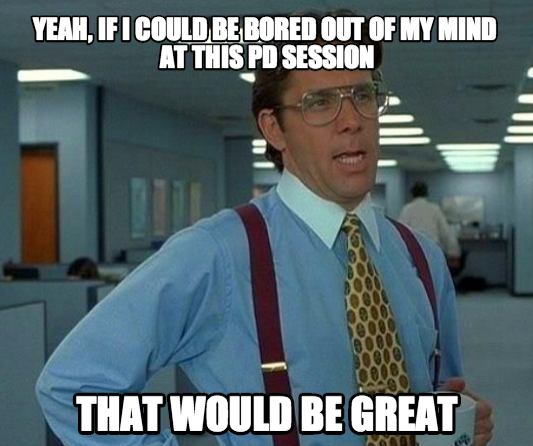
Step 1 in finding ways we could offer PD and meet the needs of teachers better is research. Both a web search and search on Pinterest turn up memes like this:
This is a little bit sad. I mean, I'm as big a fan of Office Space as the next guy, and I did laugh at this when I saw it; that's not the sad part. It's not sad that teachers don't like to sit and get information, because every teacher I know is looking for new ways to reach students. The sad part is that we're hearing things like "differentiated instruction," "hands-on," "rigor," "relevance,""genius hour," etc., and when providing PD, we're not modeling that.
If our teachers know how to make a meme and post it online, they obviously don't need to sit through a workshop that will start at the basics of technology use and work up to more advanced use. They probably even already know how to use that meme in their instruction, I mean, they're already using it appropriately when they (inappropriately) mock the delivery of professional development.
We need a change of how PD is offered and delivered. Here's some ways we can do this.
1. Online facilitation and flipped PD.
Honestly, when we have options of attending both K-12 schools and universities that are entirely online, when there is a wealth of information that can be shared through YouTube, and when MOOCs are available from some of the most respected universities in the country, why aren't we providing training online? I've had excellent results in flipping PD and have also held very rich learning experiences in online formats. Let's think outside of the box. PD doesn't have to look the way it always has before.
Here is a link to the Innovation Academy, online offerings available to any teacher starting the first of every month.
2. EdCamp approach.
I am a huge fan of EdCamps. I enjoy that I can choose what interests me and also just talk with other professionals about how things are working in their districts. This can work in schools, too, without going to an EdCamp. If you're an administrator, and you haven't attended an EdCamp, go to one so you can see what it's about. Often, our experiences shape what PD we provide, so participating in an EdCamp is important to understand the "unstructure" before planning one in your district. Here is a list of EdCamps that will take place this school year. Oh, did I mention that they are free?
3. Allow teachers to make a personal learning goal and determine what professional development they will need to achieve that goal.
As a lead learner for educational technology integration, I have created the following tool for teachers to utilize when gauging teaching practices.
Using a tool such as this, teachers can determine strengths and make goals for areas in which they feel they need improvement. Putting the goal in the teachers' hands allows them to own it, which provides motivation. There are a wealth of opportunities for learning available - everything from book studies, to partnering with a mentor and "expert" teacher that can model best practices.
4. Allow teachers to choose what they want to learn about.
A few years ago, I had the great opportunity to share my professional development plan for a district with the Marzano Research Lab. The feedback I received scared me. They said I had a good list of items I wanted to cover, but it was my list of items. The teachers had no ownership on what they were learning, it was all being fed to them from a limited menu.
I had to step outside my comfort zone and do what I had been asking teachers to do. Give my students choice.
Best. Advice. Ever. It was a two year program, and in one year, we had covered everything that was on my list. I was able to combine learning experiences instead of teach in isolation, provide the "just in time" experiences, and added to our idea generations when the group heard about something new. For example, a few participants started hearing about the flipped classroom and asked for training on how to incorporate that in their classrooms. That wasn't even on my radar when I made the PDP. Another added benefit was that I had to stay up to date in recent advances in order to provide training. It was a great experience and transformed how I both develop and provide PD for the last three years.
5. Embed PD with instructional coaches or lead learners.
This could be with instructional coaches or with the lead learner model, using model teachers to demonstrate best practices and meet with teachers during plan times on individual goals. The big benefit of this is that it takes away the "one day wonder" approach of PD, which only works about 10-15% of the time, and creates a sustained learning journey through coaching, scaffolding, and support that evidences up to 95% effectiveness. (Joyce and Showers, 2002)
So let's change the mold that comes to mind when we provide PD. Let's use these ideas so that our teachers feel like this:
Subscribe to:
Posts (Atom)