Step 1 in finding ways we could offer PD and meet the needs of teachers better is research. Both a web search and search on Pinterest turn up memes like this:
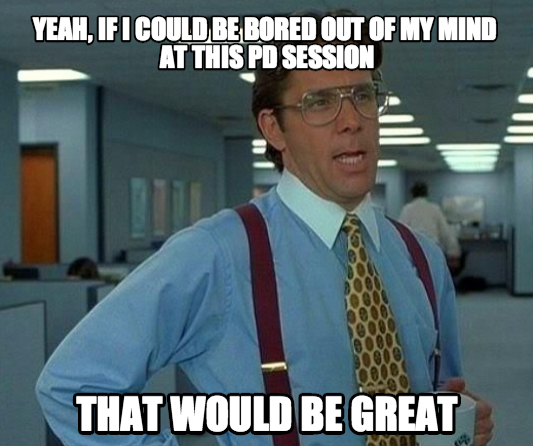
This is a little bit sad. I mean, I'm as big a fan of Office Space as the next guy, and I did laugh at this when I saw it; that's not the sad part. It's not sad that teachers don't like to sit and get information, because every teacher I know is looking for new ways to reach students. The sad part is that we're hearing things like "differentiated instruction," "hands-on," "rigor," "relevance,""genius hour," etc., and when providing PD, we're not modeling that.
If our teachers know how to make a meme and post it online, they obviously don't need to sit through a workshop that will start at the basics of technology use and work up to more advanced use. They probably even already know how to use that meme in their instruction, I mean, they're already using it appropriately when they (inappropriately) mock the delivery of professional development.
We need a change of how PD is offered and delivered. Here's some ways we can do this.
1. Online facilitation and flipped PD.

Honestly, when we have options of attending both K-12 schools and universities that are entirely online, when there is a wealth of information that can be shared through YouTube, and when MOOCs are available from some of the most respected universities in the country, why aren't we providing training online? I've had excellent results in flipping PD and have also held very rich learning experiences in online formats. Let's think outside of the box. PD doesn't have to look the way it always has before.
Here is a link to the Innovation Academy, online offerings available to any teacher starting the first of every month.
Here is a link to the Innovation Academy, online offerings available to any teacher starting the first of every month.
2. EdCamp approach.
I am a huge fan of EdCamps. I enjoy that I can choose what interests me and also just talk with other professionals about how things are working in their districts. This can work in schools, too, without going to an EdCamp. If you're an administrator, and you haven't attended an EdCamp, go to one so you can see what it's about. Often, our experiences shape what PD we provide, so participating in an EdCamp is important to understand the "unstructure" before planning one in your district. Here is a list of EdCamps that will take place this school year. Oh, did I mention that they are free?
3. Allow teachers to make a personal learning goal and determine what professional development they will need to achieve that goal.
As a lead learner for educational technology integration, I have created the following tool for teachers to utilize when gauging teaching practices.
As a lead learner for educational technology integration, I have created the following tool for teachers to utilize when gauging teaching practices.

Using a tool such as this, teachers can determine strengths and make goals for areas in which they feel they need improvement. Putting the goal in the teachers' hands allows them to own it, which provides motivation. There are a wealth of opportunities for learning available - everything from book studies, to partnering with a mentor and "expert" teacher that can model best practices.
4. Allow teachers to choose what they want to learn about.
A few years ago, I had the great opportunity to share my professional development plan for a district with the Marzano Research Lab. The feedback I received scared me. They said I had a good list of items I wanted to cover, but it was my list of items. The teachers had no ownership on what they were learning, it was all being fed to them from a limited menu.
I had to step outside my comfort zone and do what I had been asking teachers to do. Give my students choice.
Best. Advice. Ever. It was a two year program, and in one year, we had covered everything that was on my list. I was able to combine learning experiences instead of teach in isolation, provide the "just in time" experiences, and added to our idea generations when the group heard about something new. For example, a few participants started hearing about the flipped classroom and asked for training on how to incorporate that in their classrooms. That wasn't even on my radar when I made the PDP. Another added benefit was that I had to stay up to date in recent advances in order to provide training. It was a great experience and transformed how I both develop and provide PD for the last three years.
5. Embed PD with instructional coaches or lead learners.
This could be with instructional coaches or with the lead learner model, using model teachers to demonstrate best practices and meet with teachers during plan times on individual goals. The big benefit of this is that it takes away the "one day wonder" approach of PD, which only works about 10-15% of the time, and creates a sustained learning journey through coaching, scaffolding, and support that evidences up to 95% effectiveness. (Joyce and Showers, 2002)
So let's change the mold that comes to mind when we provide PD. Let's use these ideas so that our teachers feel like this:


